
DECATUR, Ill. (WAND) — E-cigarettes first came onto the market as a way to help adults quit smoking. Now they've skyrocketed in popularity among teens.
"It's never been a problem for my kids, but I know it has been seen and found at the schools," Paula Goodman, a Christian County mom, told WAND News.
The FDA estimates 2.5 million middle and high school students used e-cigarettes last year.
"My son's not into smoking or vaping. But if he was, I would have his hide—so that's not something that would be happening in our household," Venise McWard, a Tayorville mom, said.
Parents are worried about vaping, and many are talking to their kids about it.
"I've always let them know what the devices look like, so they're aware if anybody tries to give them anything, show them anything, that they're aware— they let us know," Goodman explained.

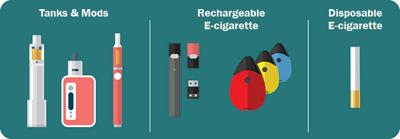
Some e-cigarettes look like regular cigarettes, cigars, or pipes. Some look like USB flash drives, pens, and other everyday items. (CDC)
The Macon County Health Department said their biggest concern is that teens often don't realize how much nicotine they're taking in.
"Teens don't necessarily look at it as, 'Ok I've had this many puffs', or 'I've smoked it this many times today,'" Emily O'Connell, a Health Educator with the Macon County Health Department, told WAND News.
There are 22-36 milligrams of nicotine in a pack of cigarettes. But just one vape cartridge can contain anywhere from three to 55 milligrams of nicotine, meaning it can be more than an entire pack of cigarettes.
"They're looking at it as 'I'm just going to keep doing it, it makes me feel better,'" O'Connell explained.
They feel better because of the hit, a dopamine release from inhaling nicotine. But that's a problem for adolescent brains.
"It changes the concentration of the development of the brain and the neurotransmitters in the brain as the kids are growing," Dr. Martin Okpalike, a pediatrician with Springboard Pediatrics, explained.
The CDC said nicotine exposure can harm the parts of a teen's brain that control attention, learning, mood and impulse control.
Dr. Okpalike said because nicotine is so addictive, up to 80% of teen vapers turn into adult smokers.
"Some of them come in with respiratory illnesses, some of them come back with generalized body pain. A lot of them have depression or motivation problems," Dr. Okpalike added.
Experts said there is a misconception that e-cigarettes are safer than other tobacco products.
"Vaping is sometimes people look at it as a safe alternative. It is not. They are finding more and more about these products and how dangerous they really are," O'Connell explained.
This July, the American Heart Association (AHA) said e-cigarette use can have long term impacts on your heart, blood vessels and lungs.
"Issues that we see with cigarettes, are the same issues that are also popping up with vaping. We've seen children develop lung issues that they shouldn't have," Dr. Okpalike said.
In addition to the nicotine, the AHA is worried about flavoring ingredients, and other chemicals, in the e-cigarette liquid.
"The market is not fully regulated. A lot of the product, we are not exactly sure what is present," Dr. Okpalike explained.
The Macon County Health Department is now working with school districts to teach kids about the danger of these products.
"There's a lot of things found within the vaping products that can cause cancer, it can cause lung issues, heart issues," O'Connell added.
The MCHD curriculum includes information about how to spot nicotine addiction, how to say no to vaping, and healthy alternatives to manage stress.
"A lot of people turn to vapes or even cigarettes as a stress reliever, but it works the opposite way, it causes more stress on that person," O'Connell said.
Staff can also help parents who find out their child is using e-cigarettes.
"As hard as it may be to know that your child is addicted to something, it's important to be there for them because they don't have that extra support that they're looking for, and now they're addicted and need the help," O'Connell added.
On July 28th, Governor J.B. Pritzker signed a bill banning the use of e-cigarettes in indoor public spaces.
Copyright 2023. WAND TV. All rights reserved.