BOGOTÁ, Colombia (AP) — An “abhorrent” violation of Latin American sovereignty. An attack committed by “enslavers.” A “spectacle of death” comparable to Nazi Germany’s 1937 carpet bombing of Guernica, Spain.
There is perhaps no world leader criticizing the Trump administration’s attack on Venezuela as strongly as left-wing President Gustavo Petro of Colombia, historically Washington's most important ally in the region.
For the past 30 years, the U.S. has worked closely with Colombia, the world’s largest producer of cocaine, to arrest drug traffickers, fend off rebel groups and boost economic development in rural areas.
But while other officials tread carefully, Colombia's outspoken president has seized on the U.S. capture of Venezuelan President Nicolás Maduro to escalate his spiraling war of words with President Donald Trump, who said a U.S. military operation in Colombia “sounds good to me."
In recent days, Trump has repeated allegations that Petro is “an international drug leader” despite the lack of evidence.
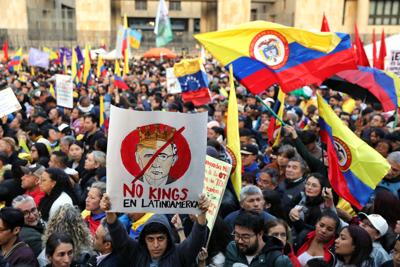
Answering a protest call issued by Petro, thousands of Colombians gathered in public squares across the country Wednesday “to defend national sovereignty" against Trump's military threats, chanting slogans against the U.S. president and waiting anxiously to hear what they expected would be Petro’s latest salvo in his dramatic clash with Trump.
In downtown Bogotá, Colombia’s capital, Petro opened with: “I had one speech prepared for today, but I have to give another one.”
Instead, to everyone's surprise, the Colombian president appeared to offer an olive branch to Trump. Just minutes earlier, Petro said, he had held a friendly call with his U.S. counterpart and explained that his only connection to drug trafficking was his fierce commitment to fighting against it.
“Trump isn't stupid,” Petro told the crowd. “The extreme right ... deceived Trump, and that’s why he came out saying something that would sound absurd to any citizen who hears it, that ‘Petro is the head of drug trafficking.’”
Trump released a statement on social media, calling it a “Great Honor” to speak with Petro. He even invited his fiercest critic to the White House.
“I appreciated his call and tone, and look forward to meeting him in the near future,” Trump wrote of Petro.
The sudden détente revealed that, for all their ideological differences, Petro and Trump share a key characteristic: an apparent willingness to side with a rival if deemed to be in their best interest.
For Colombia, the U.S. remains critical to the military's fight against leftist guerrillas and drug traffickers. Washington has provided Bogotá with roughly $14 billion in the last two decades.
For the U.S., Colombia remains the main source of intelligence used to interdict drugs in the Caribbean, and the cornerstone of its counternarcotics strategy abroad.
“The Colombians are extremely effective in taking advantage of their contacts in Washington, on the Hill and elsewhere, and the private sector is mobilized," said Michael Shifter, a Latin America expert at the Inter-American Dialogue think tank in Washington.
“People were trying to tell Trump: ‘Look, you can punish Petro to the extent possible, but you don’t want to punish the country. That undermines the fight against drugs and is going to be harmful for the United States.'"
Trump and Petro hate each other
Petro has drawn Trump’s ire for months.
He has turned back U.S. military deportation flights, urged American soldiers to disobey Trump during a pro-Palestinian rally in New York, lambasted U.S. attacks on alleged drug vessels as “murder,” and sparred with Trump over Israel’s war in Gaza and his crackdown on immigration.
Infuriated, Trump has deployed language that he often used to describe Maduro, calling Petro a “lunatic” and an “international drug leader.” He has revoked Petro’s U.S. visa; slapped sweeping sanctions on him, his relatives and his interior minister on drug-related grounds; vowed to end all U.S. aid to Colombia; and threatened punitive tariffs on Colombian exports.
Thrilled by Maduro’s ouster, Trump pushed the fight further in recent days. He called Petro a “sick man who likes making cocaine and selling it to the United States” and warned of a possible U.S. military operation on Colombian soil.
Petro convened emergency meetings before the United Nations and the Organization of American States. He galvanized nationwide anti-Trump protests Wednesday where banners read, “The U.S. is the biggest threat to world peace.”
And the former leftist guerrilla even threatened to take up arms against the U.S. to defend Colombia.
Petro’s high-stakes gambit has put Colombia, long America’s staunchest regional ally, in Trump’s crosshairs and his government in a bind: how to reap the political rewards of standing up to Washington just months before a presidential election without jeopardizing crucial security assistance or goading Trump into making good on his threat to invade.
Petro plays the fight to his advantage
Frustrated with congressional resistance to his contentious reforms, failing to fulfill his promise of “total peace” with armed groups and facing a series of electoral tests, Petro has found in Trump the perfect foil as he fights for his legacy.
“He wants this stage where he is the clearest adversary, rhetorically or politically, to the U.S.,” said Sergio Guzman, a political risk analyst based in Bogotá.
The constitution bars Petro from seeking another term in May's presidential vote but the country's first leftist president wants his coalition to retain power over the resurgent right that blames his unpopular government for rising crime. Colombia will also hold legislative elections in March.
On Wednesday, Petro's strategy of playing David to Trump’s Goliath looked to have paid off. While Trump's threats seemed excessive enough to citizens that it provoked widespread sympathy for Petro, the Colombian leader managed to exit the scuffle before the verbal conflict could spill into a military one and threaten the country's most vital relationship.
“The priority is peace, and peace is achieved through dialogue," Petro told protesters after his conversation with Trump. “Colombia can sleep soundly.”
Alarm was growing in Colombia over Trump's threats
Experts assessed a U.S. military operation against Petro who, unlike Maduro, was democratically elected, to be unlikely.
But complicating the calculation for Colombian officials were Trump's increasingly militaristic comments about Latin America that lumped Colombia in with Venezuela as a source of narcotics and immigrants in the U.S.
“Whereas the Colombian institutions still maintain cooperation and have a lot to lose, Petro personally feels like that bridge has already burned,” said Elizabeth Dickinson, a senior analyst at the International Crisis Group.
Recent statements from top ministers betrayed the rising alarm.
As Petro fired more salvos on social media earlier this week, Colombia’s interior and justice ministers scrambled to put out the fire, announcing they had notified U.S. intelligence agencies the government would “continue to coordinate and cooperate in the fight against drug trafficking.”
In a news conference on Tuesday, Foreign Minister Rosa Villavicencio insisted that Colombia was trying to resolve the tensions with Trump diplomatically. Yet against all odds, she said, Colombia had been forced to prepare for “the possibility of aggression against our country by the United States.”
“For this, we have a highly trained, very well prepared army,” she said.
Indeed, the army has long received training from the U.S.
DeBre reported from Buenos Aires, Argentina. Associated Press writer Gaby Molina in Bogotá, Colombia, contributed to this report.
Follow AP’s coverage of Latin America and the Caribbean at https://apnews.com/hub/latin-america


