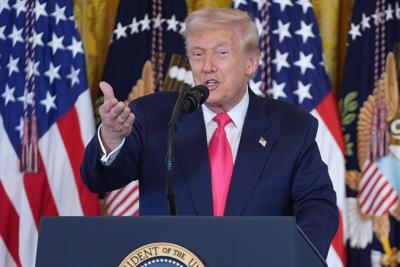
TEGUCIGALPA, Honduras (AP) — Hondurans voted Sunday to elect a new president only days after U.S. President Donald Trump intervened in a close race with an endorsement of one candidate and announced that he would pardon a former president.
Shortly before polling stations were scheduled to close, the National Electoral Council announced that polling places would have the option of staying open for another hour if the station committee of party representatives agreed to do so. Regardless, polling places had to stay open until the last person in line could vote.
In addition to a new president, voters were casting ballots for a new Congress, as well as hundreds of local positions.
Main candidates
Among the five presidential candidates on the ballot, polls indicated three had a chance to win and were finishing in close competition. They are:
1. Rixi Moncada who served as finance and later as defense secretary in the current administration of President Xiomara Castro and is running for the social democrat LIBRE or Liberty and Re-foundation party.
2. Salvador Nasralla, who is making his fourth bid for the presidency, this time as the candidate for the conservative Liberal Party.
3. Former Tegucigalpa Mayor Nasry “Tito” Asfura, who carries the mantle of the also conservative National Party.
Moncada promises to “democratize” an economy still defined by extreme wealth and poverty. Nasralla casts himself as the outsider who can clean up the country’s endemic corruption. And Asfura is trying to restore the National Party as a pro-business force tarnished by previous bouts of presidential corruption.
Campaign issues
Honduras’ security situation has improved in recent years as homicides across the region continue to fall, but it still has Central America’s highest homicide rate. Hondurans say security and jobs remain their top priorities, despite an economy that has strengthened during Castro’s administration.
The presidential contest had mostly focused on candidates trading accusations of plans to manipulate the vote until this past week when Trump endorsed Asfura while attacking his opponents, the latest signal of the United States’ renewed interest in Latin America.
U.S. president's intervention
Then Trump shocked Hondurans by announcing Friday that he would pardon ex-President Juan Orlando Hernández, who was serving a 45-year sentence in a U.S. prison for helping drug traffickers moving cocaine to the United States.
It was unclear what impact Trump would have on the election, but it was the latest show of the U.S. government’s willingness to directly involve itself in the region and came at a time of already heightened tensions because of the U.S. military buildup in the Caribbean and Trump’s threats against Venezuela President Nicolás Maduro.
When asked why he pardoned Hernández, Trump argued that he was answering the calls of Hondurans who believed the case was politically motivated.
“The people of Honduras really thought he was set up, and it was a terrible thing,” Trump told reporters traveling with him on Air Force One later Sunday.
“They basically said (Hernández) was a drug dealer because he was the president of the country. And they said it was a Biden administration set-up. And I looked at the facts and I agreed with them."
But in Honduras, many were left unnerved by the sudden U.S. attention, and hoping at a minimum for a peaceful election.
Divergent views
Cristian Zelaya, a 42-year-old systems engineer, said that his priority in the voting booth was “to try to rescue the country from a future like Venezuela.” He said that he wanted to get the “Communists” out, in reference to the governing social democrat LIBRE party, which he said made big promises, but didn't deliver.
He praised Trump’s decision to pardon Hernández, who he considered a good president, but said it had no impact on his decision.
In another part of the capital, Carlos Alberto Figueroa, a 71-year-old retiree, said that he wanted Moncada to continue President Castro’s work, which he said had already resulted in “development, a better economy and security.”
But he too discounted Trump’s impact, saying the Honduran people would decide.
Nancy Serrano, 20, was voting for the first time and top of mind for her was “enough with corruption.”
Serrano is studying to be a teacher and she worries that the high prevalence of corruption limits opportunities for the youth and eats away at the economy.
Election details
In announcing the start of voting Sunday, National Electoral Council President Ana Paola Hall called on the candidates to respect the rules to not declare victory before the council confirms a winner.
There were reports of some polling places opening late, but apparently voting was relatively smooth. The council planned to provide preliminary results at 9 p.m. (0300 GMT Monday), but has up to 30 days to officially announce the final result.
More than 4,000 Honduran and foreign election observers had fanned out to the nearly 6,000 polling places across the country.
This story has been corrected to show that Moncada made the comment about promising to “democratize” the economy, not Castro.


