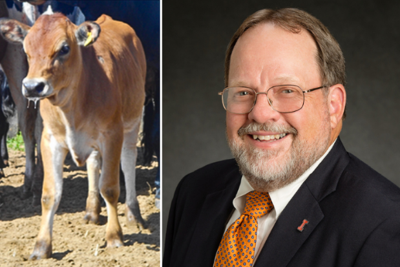
(WAND) - University of Illinois Urbana-Champaign has helped lead a project to create the first insulin-producing cow.
A cow from the south of Brazil is the first transgenic cow capable of producing human insulin in her milk.
The study was led by researchers at the U of I and the Universidade de São Paulo with the goal of one day eliminating the drug scarcity and high costs for people living with diabetes.
“Mother Nature designed the mammary gland as a factory to make protein really, really efficiently. We can take advantage of that system to produce a protein that can help hundreds of millions of people worldwide,” said Matt Wheeler, professor in the Department of Animal Sciences, part of the College of Agricultural, Consumer and Environmental Sciences (ACES) at U. of I.
He is also affiliated with the Carle Illinois College of Medicine, The Grainger College of Engineering, the College of Veterinary Medicine, the Beckman Institute, and the Carl R. Woese Institute for Genomic Biology.
Wheeler is the lead author on a new Biotechnology Journal study describing the development of the insulin-producing cow.
Wheeler’s colleagues in Brazil put a segment of human DNA coding for proinsulin, the protein precursor of the active form of insulin, into cell nuclei of ten cow embryos. Those were implanted in the uteruses of normal cows in Brazil, and one transgenic calf was born. The human DNA was targeted for expression, the process whereby gene sequences are read and translated into protein products, in mammary tissue only.
“In the old days, we used to just slam DNA in and hope it got expressed where you wanted it to,” Wheeler said. “We can be much more strategic and targeted these days. Using a DNA construct specific to mammary tissue means there’s no human insulin circulating in the cow’s blood or other tissues. It also takes advantage of the mammary gland’s capabilities for producing large quantities of protein.”

Matt Wheeler, pictured, helped develop the first transgenic cow to produce human insulin in her milk.
When the cow matured, the team unsuccessfully tried to impregnate her using standard artificial insemination techniques. Instead, they stimulated her first lactation using hormones. The lactation yielded milk, but a smaller quantity than would occur after a successful pregnancy.
Still, human proinsulin and insulin were detectable in the milk.
“Our goal was to make proinsulin, purify it out to insulin, and go from there. But the cow basically processed it herself. She makes about three to one biologically active insulin to proinsulin,” Wheeler said. “The mammary gland is a magical thing.”
The insulin and proinsulin, which would need to be extracted and purified for use, were expressed at a few grams per liter in the milk. Because the lactation was induced hormonally and the milk volume was smaller than expected, the team is not able to say exactly how much insulin would be made in a typical lactation.
A cow could make 1 gram of insulin per liter and a typical Holstein makes 40 to 50 liters per day. The typical unit of insulin equals 0.0347 milligrams.
“That means each gram is equivalent to 28,818 units of insulin,” Wheeler said. “And that's just one liter; Holsteins can produce 50 liters per day. You can do the math.”
The team plans to re-clone the cow.
Eventually, they hope to create transgenic bulls to mate with the females, creating transgenic offspring that can be used to establish a purpose-built herd.
Wheeler believes even a small herd could quickly outcompete existing methods for producing insulin.
“With regard to mass-producing insulin in milk, you’d need specialized, high-health-status facilities for the cattle, but it’s nothing too out of the ordinary for our well-established dairy industry,” Wheeler said. “We know what we’re doing with cows.”
FDA approval would be needed, as well as an efficient system to collect and purify insulin products before transgenic cows could supply insulin for diabetics.
“I could see a future where a 100-head herd, equivalent to a small Illinois or Wisconsin dairy, could produce all the insulin needed for the country,” he said. “And a larger herd? You could make the whole world’s supply in a year.
The study, “Human proinsulin production in the milk of transgenic cattle,” is published in Biotechnology Journal [DOI: 10.1002/biot.202300307].
Copyright 2024 WAND TV. All rights reserved.


