WASHINGTON (AP) — The FBI made an arrest on Thursday in its nearly 5-year-old investigation into pipe bombs placed outside the headquarters of the Republican and Democratic national parties in Washington on the eve of the Jan. 6, 2021, riot at the U.S. Capitol.
The arrest marks the first time investigators have settled on a suspect in an act that had long vexed law enforcement, spawned a multitude of conspiracy theories and remained an enduring mystery in the shadow of the dark chapter of American history that is the violent Capitol siege.
The suspect in custody has been identified as Brian Cole, according to three people familiar with the matter. Two of the people said he lived in Woodbridge, Virginia, a suburb of Washington, D.C.
No other details were immediately available, including the charges Cole might face. The people who described the arrest weren't authorized to publicly discuss a case that hasn't yet been made public and spoke on the condition of anonymity.
Calls to relatives of Cole listed in public records weren't immediately returned on Thursday.
FBI says the bombs could've killed people
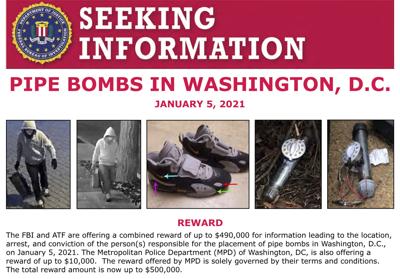
The pipe bombs were placed on the evening of Jan. 5, 2021, near the offices of the Democratic and Republican national committees. Nobody was hurt before the bombs were rendered safe, but the FBI has said both devices could have been lethal.
In the years since, investigators have sought the public’s help in identifying a shadowy subject seen on surveillance camera even as they struggled to determine answers to basic questions, including the person’s gender and motive and whether the act had a clear connection to the riot at the Capitol a day later when supporters of President Donald Trump stormed the building in a bid to halt the certification of the Republican's 2020 election loss to Democrat Joe Biden.
Seeking a breakthrough, the FBI last January publicized additional information about the investigation, including an estimate that the suspect was about 5-foot-7, as well as previously unreleased video of the suspect placing one of the bombs.
The bureau had for years struggled to pinpoint a suspect despite hundreds of tips, a review of tens of thousands of video files and a significant number of interviews.
Lack of evidence spawns conspiracy theories
In the absence of harder evidence, Republican lawmakers and right-wing media outlets promoted conspiracy theories about the pipe bombs. House Republicans also criticized security lapses, questioning how law enforcement failed to detect the bombs for 17 hours. Dan Bongino, the current FBI deputy director, floated the possibility last year before being tapped for his job that the act was an “inside job” and involved a “massive cover-up.”
The FBI’s top two leaders, Bongino and Director Kash Patel, sought to breathe new life into the investigation despite having openly disparaged the bureau’s broader approach to the Jan. 6 siege and despite Trump's pardons on his first day back in office of the rioters who stormed the Capitol, including those who violently attacked police with poles and other makeshift weapons.
In a long Nov. 13 post on X, Bongino wrote that the FBI had brought in new personnel to examine the case and "dramatically increased investigative resources" along with the public reward for information “to utilize crowd-sourcing leads.” He said in the same post, addressed to Republican Rep. Thomas Massie of Kentucky, that “a week of near 24-hour work on RECENT open source leads in the case has yet to produce a break through.”
Investigators hunt for clues
Public attention over the years had centered in part on surveillance video taken the night before the riot showing the suspect spending close to an hour moving through the surrounding blocks, pausing on a park bench, cutting through an alley and stopping again as a dog walker passed.
The person wore a light sweatshirt, dark pants and sneakers, with a dark backpack slung over one shoulder. Investigators have long said the gait suggested the person was a man, but a surgical mask and hood rendered the face all but impossible to see.
Agents paired their video review with a broad sweep of digital records. They gathered cell tower data showing which phones were active in the neighborhood at the time and issued subpoenas to several tech companies, including Google, for location information.
Investigators also analyzed credit card transactions from hobby shops and major retailers to identify customers who had purchased components resembling those used in the two explosive devices — each roughly 1 foot (0.3 meters) long and packed with gunpowder and metal, according to two law enforcement officials familiar with the investigation.
Another avenue of the investigation centered on the suspect’s shoes, believed to be Nike Air Max Speed Turfs. After learning from Nike that thousands of pairs had been distributed through more than two dozen retailers, agents filed subpoenas for credit card records from Foot Locker and other chains as they worked to narrow down potential buyers. Still, for years, they had no solid breakthroughs.
Copyright 2025 The Associated Press. All rights reserved. This material may not be published, broadcast, rewritten or redistributed without permission.