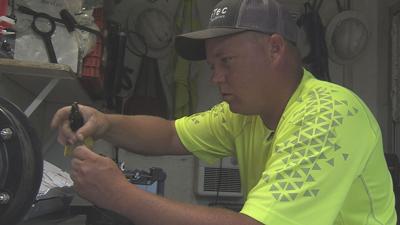
LOVINGTON, Ill. (WAND)- At Okaw Farmer’s Coop here, workers rely on good internet connections to manage their books and access the Chicago Board of Trade.
Often, though, those connections are too slow.
“I could enter a ticket and sit here and look at the computer, waiting for the ticket to get entered, because it’s just so slow,” said Gary Smith. “A lot of the technology the farmers have now, they download what they’ve done during the day … sometimes in the morning, they’ve got to look and see ‘Did it get downloaded, or is it still working on it … or did it fail?’”
Federal law calls for the deployment of “advanced telecommunications capability” to all Americans, but the Federal Communications Commission reports that 34 percent of Americans lack that access when it comes to broadband internet service.
The FCC reported last year that 39 percent of Americans in rural areas lack broadband service, compared with only four percent in urban areas.
That lack of broadband access in rural areas can limit the work of people in healthcare, education, emergency response and business, and can limit the ability of people to stay in small communities, communications experts say.
“It can be something as simple as billing,” said Joshua Sedemann of the Rural Broadband Association. “If you’re in rural America and you have access to broadband, you can really work anywhere. There are certainly limits to telecommuting, but it does open up opportunities.”
In recent months, workers have been running new fiber optic cable to homes, businesses and other institutions around Lovington to provide them with new broadband internet access, a project supported by a $4 million USDA grant to Moultrie Independent Telephone and its parent company, Shawnee Communications.
“It’s a complete overbuild of the network in Lovington,” said Matt Johnson, Vice President of Government Policy for Shawnee Communications. “We’re putting in a brand-new fiber optic network. We’re putting in brand new equipment in our central office that will give people extremely high speed connections.”
At the coop, that new technology could mean significant change.
“We’ll be able to trade instantly,” Smith said. “They’re going to bring fiber optic fiber into our facility … go to the top of our elevator. We’ll be able to shoot it anywhere we want to instantly.”


