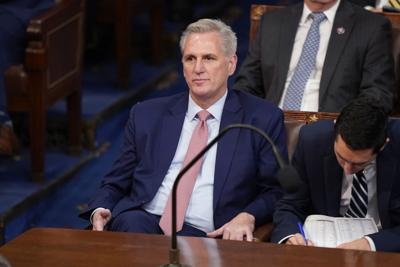
WASHINGTON (NBC) — A band of ultraconservative rebels on Tuesday twice blocked House GOP Leader Kevin McCarthy from securing the speaker’s gavel in the first votes of the new Republican majority, marking the first time the House has gone to multiple ballots to elect a speaker in 100 years.
In the dramatic televised vote on the House floor, McCarthy, of California, received support from an overwhelming majority of his GOP Conference, with 203 votes, but that was short of the 218 needed to win a simple majority of the 434 House members present. McCarthy lost a second round of voting by the same amount.
Nineteen conservatives cast their votes for other candidates in the first round, with the majority backing one of McCarthy’s chief antagonists, former Freedom Caucus Chairman Andy Biggs, R-Ariz. Rep. Jim Jordan, R-Ohio, received six votes, while Rep. Jim Banks, R-Ind., former Rep. Lee Zeldin, R-N.Y., and Rep. Byron Donalds, R-Fla., each received one vote.
All 19 cast their ballots for Jordan in the second round.
Meanwhile, Democrats unanimously rallied behind the minority leader, Rep. Hakeem Jeffries of New York both times. As is customary during the first vote of the new Congress, lawmakers stood and cast their vote for speaker aloud when their name was called. Jeffries ended up with more votes than McCarthy — 212.
It’s unclear where Republicans go from here. Neither McCarthy allies nor his hard-right enemies are backing down. House rules require lawmakers to keep holding votes for speaker until someone secures 218 votes or a simple majority of members voting. No other House business can occur until a speaker is selected, which means floor votes, committee hearings and other congressional work will grind to a halt if Republicans can’t agree on a new leader.
The last time a speaker vote went to multiple ballots was in 1923, when Speaker Frederick Gillett, R-Mass., won re-election on the ninth ballot.
The House moved to a second round of voting shortly after 2 p.m. ET, with Jordan nominating McCarthy as speaker. He told his fellow Republicans that their differences "pale in comparison" to those between Republicans and Democrats. "We better come together," Jordan said, adding, "I think Kevin McCarthy is the right guy to lead us. I really do."
Jordan was followed by Rep. Matt Gaetz, R-Fla. — who nominated Jordan for the job. "I'm nominating him and I'm voting for him," Gaetz said.
Despite Jordan's call for unity behind McCarthy, the 19 Republicans unified behind Jordan.
It’s an inauspicious start for House Republicans, who recaptured the majority in the November midterms but begin the new Congress bitterly divided and without agreement on who should lead the party.
Tuesday's vote caps a weeklong standoff between McCarthy and a small band of far-right members close to former President Donald Trump who vowed to stick together to deny him the speaker’s gavel. Because the GOP’s new 222-212 majority is so thin, as few as five GOP lawmakers are able to block him from winning the top job.
Five conservatives — the so-called Never Kevins led by Biggs and Gaetz — said they wouldn’t vote for McCarthy under any circumstance, and urged him to drop out to allow another candidate to step forward.
In recent days, Republicans have resorted to name-calling and making threats against their fellow GOP colleagues. One McCarthy ally, Rep. Kat Cammack, R-Fla., accused McCarthy foes of opposing him just to pad their campaign coffers.
“Who’s raising money off of standing up to power, while conveniently forgetting that Kevin McCarthy funded their campaigns, that he came to their districts and did events for them,” Cammack said. “And now they’re sending out emails saying, ‘Oh, give me $5 because I’m standing up to the establishment and draining the swamp.’”
“I don’t care if it’s the first ballot or the 97th ballot, Kevin McCarthy will be speaker of the House,” she said.
Rep. Dan Crenshaw, R-Texas, was less diplomatic in expressing his frustration with the McCarthy opponents.
“There’s a group of people who have deeply miscalculated,” Crenshaw said. “They’ve calculated that people will see them as these noble freedom fighters fighting for a cause. They can’t seem to say what the cause is. That makes them look pretty f---ing stupid. And they are pretty f---ing stupid.”
Ascending to the speakership has been a career ambition for McCarthy, 57, a former House staffer and minority leader of the California Assembly in Sacramento who methodically rose through the ranks of the House GOP leadership team for the past 14 years.
As majority leader, he ran for speaker after John Boehner resigned in 2015. But Freedom Caucus members, complaining that he was insufficiently conservative, withheld their support and he dropped out of the race, paving the way for Paul Ryan to take the job.
“It is true that we struggle with trust with Mr. McCarthy because time and again his viewpoints, his positions, they shift like sands underneath you,” Gaetz told reporters before Tuesday’s vote. “If you want to drain the swamp, you cannot put the biggest alligator in charge of the exercise.”
During a 90-minute closed-door conference meeting before Tuesday’s vote, McCarthy made a fiery last-minute plea, defending his work as leader and urging his GOP colleagues to rally behind him. McCarthy’s allies, meanwhile, have threatened some of his detractors with having their committee assignments taken away, Biggs said after the meeting. Rep. Mike Rogers, R-Ala., confirmed he had “promised” those planning to vote against McCarthy that they would lose their committee positions.
Emerging from the meeting, a defiant McCarthy said he was preparing for a protracted floor fight with his opponents and showed no signs of dropping out.
“I will always fight to put the American people first, not a few individuals that want something for themselves,” McCarthy said, flanked by his supporters. “So we may have a battle on the floor but the battle is for the conference and the country, and that’s fine with me.”
McCarthy was nominated Tuesday by Rep. Elise Stefanik, R-N.Y., who earned a standing ovation from the vast majority of the Republican caucus for her speech praising McCarthy as “a proud conservative with a tireless work ethic.”
“Kevin McCarthy has earned the speakership of the People’s House,” Stefanik said.
Rep. Paul Gosar, R-Ariz., nominated Rep. Andy Biggs, R-Ariz., for speaker as an alternative to McCarthy.
Rep. Pete Aguilar, D-Calif., nominated Rep. Hakeem Jeffries of New York as speaker, while throwing shade at the Republicans in his speech.
“House Democrats are united behind a speaker,” Aguilar said, adding Jeffries “does not traffic in extremism. He does not grovel to or make excuses for a twice-impeached former president. He does not a bend a knee to anyone who would seek to undermine our democracy.”
“That’s not what leaders do," Aguilar said.
Gaetz and other McCarthy opponents held a news conference Tuesday morning insisting they are in for the long haul. "Pardon my resolve,” he said. “This town desperately needs change, and if it’s a few of us who have to stand in the breach to force it, we are willing to do so as long as it takes.”
As Tuesday's vote showed, McCarthy's troubles aren't limited to the Gaetz group. In a bid to win support from a separate group of Trump-aligned House Freedom Caucus members, McCarthy did agree over the weekend to a suite of rule changes that would water down his powers as speaker.
But nine members of that group, including Freedom Caucus Chairman Scott Perry, R-Pa., characterized his proposals as too little, too late.
In their New Year's Day letter, they wrote that he failed to address a number of their demands, like ensuring leadership doesn’t work to defeat some conservative candidates in open primary races. The members also said McCarthy's proposed rule changes would still be too restrictive of members' ability to oust the speaker in the middle of the Congress.
"Despite some progress achieved," the Freedom Caucus group wrote, "Mr. McCarthy’s statement comes almost impossibly late to address continued deficiencies ahead of the opening of the 118th Congress on January 3rd."
McCarthy, who has Trump's endorsement and easily defeated Biggs to win his party's nomination for speaker, isn’t backing down. He is already moving into the speaker’s suite and his die-hard loyalists, who call themselves the “Only Kevins,” have pledged to go to the mat for him and block any rival who emerges.
“You can’t beat somebody with nobody. So who’s going to beat McCarthy? Who’s going to get 218 votes on the floor? Nobody else but him,” moderate Rep. Brian Fitzpatrick, R-Pa., a leader of the bipartisan Problem Solvers Caucus, told reporters.
Fitzpatrick said he will vote for McCarthy “first round, 1,000th round and every one in between,” adding, “And there’s a ton of us like that.”
In all, 19 Republicans voted against McCarthy in the first round — Reps. Biggs of Arizona, Dan Bishop of North Carolina, Andrew Clyde of Georgia, Eli Crane of Arizona, Gaetz of Florida, Bob Good of Virginia, Gosar of Arizona, Ralph Norman of South Carolina, Scott Perry of Pennsylvania, Matt Rosendale of Montana, Lauren Boebert of Colorado, Michael Cloud of Texas, Anna Paulina Luna of Florida, Mary Miller of Illinois, Andrew Ogles of Tennessee, Keith Self of Texas, Josh Brecheen of Oklahoma, Andy Harris of Maryland and Chip Roy of Texas.
The showdown could have major implications for the House, with additional votes dominating the floor. That could delay new House GOP investigations into the Biden administration's handling of the border, the Covid-19 response and the U.S. withdrawal from Afghanistan.
"The refusal of a small group of individuals to coalesce around who the vast majority voted for hurts the entire team and will slow us down right from the start," said another McCarthy ally, Rep. Don Bacon, R-Neb.


