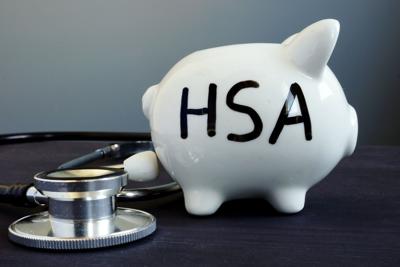
In Illinois and around the country, the number of workers choosing high deductible health insurance plans has been on the rise. And at first glance, it’s easy to understand why—those plans take less money out of an employee’s paycheck in the form of a premium, leaving the worker to pay more only if medical attention is needed. It’s a deal more and more Americans are finding too good to pass up.
But what happens when those medical issues do arise, and workers in those high deductible health plans are stuck with potentially huge bills because their deductibles haven’t been met? Well, that’s when it helps to have a little something in reserve—a plan that starts by opening a health savings account (known as an HSA) at Prospect Bank.
“What the health savings account does is allow you to save funds for qualified medical expenses that can be used for yourself, for your spouse, or any of your dependents,” says Brittany Cluver, Chief Deposit Officer at Prospect Bank, which is headquartered in Paris and has been serving Central Illinois since 1873.
“From your co-pays to your prescriptions to medical bills, if you have any procedures or need contact lenses or eyeglasses—those are typical qualified medical expenses that would be covered by a health savings account. One of the big benefits is that this money is essentially yours forever, and you can name beneficiaries on the account. If something were to happen to you, the money can be carried on to a spouse. So, it's not ‘use it or lose it.’”
A flexible way to cover costs
HSAs are available only to those covered by high deductible health insurance policies, and the IRS determines qualified medical expenses. But the list is vast and ever-expanding, recently including telehealth and various over-the-counter products. And it’s simple to use—medical expenses can be paid via a debit card linked to the HSA account, or through Prospect Bank’s online services.
“It's very flexible,” Cluver says. “If you spend the money out of your normal operating account, you can transfer the money over. And as long as you have a receipt to prove this is how much you spent on it and can document that transaction, it's pretty flexible as to how you can use it. There are even some customers that pay all their normal medical expenses throughout the entire year, keep a tally of it, and then make one big transfer from their health savings account to their normal personal account at the end of the year. And that satisfies the need. So, there are different methods to gain access to those funds.”
HSAs also carry an additional benefit: contributions are tax-free, although the IRS does limit how much users can put into an account per year—which for 2022 is $3,650 for an individual or $7,300 for a family. Prospect Bank pitches in through tiered interest rates, which pay 0.2 percent for amounts up to $4,999.99, 0.4 percent for amounts between $5,000 and $14,999.99, and 0.6 percent for amounts of $15,000 and above.
Much like a 401(k), HSAs also have withdrawal restrictions. Using the money for any nonmedical expenses before age 65 means the account holder must pay income taxes on the amount as well as an additional 20 percent penalty. After 65, withdrawals for nonmedical expenses don’t incur a penalty, although the account holder must still pay taxes on the amount.
While users can’t continue to make HSA contributions once they’re enrolled in Medicare, between the ages of 55 and 65 they can make extra contributions of up to $1,000 over the annual limit to help them prepare financially for retirement. And again—the money never goes away. At any age, you’re always able to pull from your Prospect Bank HSA to help pay for qualified medical expenses as determined by the IRS.
“You can still use it at age 80 for a hip replacement, or whatever the case may be,” Cluver says.
Even young adults can benefit
But consumers should be thinking of HSAs well before that point—after all, it’s young, healthy people with few medical problems who typically gravitate to high deductible health plans and would have the most to benefit from an HSA they can open now and save for whenever it’s needed. In some cases, employers will make contributions to their workers’ HSAs, money that’s left on the table without a health savings account. Cluver knows the benefits well—she’s used her HSA to pay for things like braces and eyeglasses for her children.
Cluver and her staff at Prospect Bank work to spread the word about HSAs, sending out literature and speaking to employers about the advantages of having a health savings account. Some people who have long been accustomed to the standard premium/deductible method may not even be aware that another avenue is available to them. “It’s asking them to take that step outside the box,” Cluver says, “and realize that by using this HSA with your high deductible plan, you’re saving for your future.”
Interested in exploring more about what a Prospect Bank health savings account can do for you? Visit one of its ten locations across Central Illinois and Indiana, including Terre Haute, call (877) 465-4154, or visit BankProspect.com for further information.


