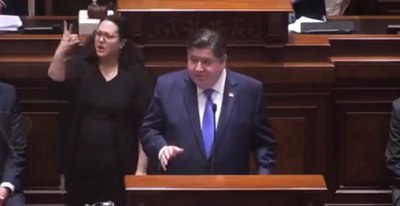
SPRINGFIELD, Ill. (WAND) - Governor JB Pritzker delivered his sixth State of the State address and budget plan for the state of Illinois Wednesday afternoon.
WATCH:
The annual address comes one week after Pritzker pledged $182 million in funding to help the City of Chicago address an influx of thousands of migrants.
NBC Chicago reports the state faces a steep budget shortfall of nearly $900 million for the coming fiscal year, which begins July 1.
In last year's address, Pritzker proposed universal schooling for 3- and 4-year-olds, starting with $440 million to finance 5,000 additional seats for the 2023-2024 school year, more childcare opportunities and facility construction.
In a summary of this year's address, Pritzker said the budget proposal contains historic investments in early childhood education, K-12 public schools, and the teacher pipeline. The budget also advances Home Illinois, a whole of government approach to ending homelessness as we know it... funding a joint effort between the state, Cook County, and the City of Chicago to welcome asylum seekers.
He also unveiled new efforts to make healthcare affordable and accessible for all, including a plan to eliminate $1 billion in medical debt for low-income state residents.
Pritzker is advancing health equity, funding initiatives to address maternal mortality as a whole and maternal mortality for black women in particular, and new protections for health insurance consumers from "unfair industry practices."
Governor Pritzker said in the last five years, the state has:
- Received nine credit rating upgrades
- Raised the budget stabilization ("Rainy Day") fund to over $2 billion
- Reduced outstanding accounts payable and short-term borrowing from $9.248 billion as of 12/31/18 to less than $450 million at the end of FY25 (an $8.8 billion reduction)
- Paid down the $8 billion bill backlog
- Passed five balanced budgets
- Surpassed a trillion-dollar economy with Gross Domestic Product at $1.092 trillion
In FY25, Pritzker said the state projects a surplus of $298 million, adjusted to $128 million after the statutory Budget Stabilization Fund calculation. The Proposed Total expenditure for the upcoming fiscal year is $52.697 billion.
When it comes to education, Pritzker said Smart Start will get $400 million in new and maintained funding. The FY25 budget includes over $170 million in general funds for Smart Start through DHS.
The Governor proposed creating a new agency specifically focused on early childhood to make it easier for parents to access services. He said it will bring together programs that were under three separate agencies to streamline services. The budget includes $13 million to start building out this agency.
The new Department of Early Childhood will spend the next two years planning for the transition of services from the legacy agencies (ISBE, DHS, and DCFS). It will start administering early learning programs in FY27.
Other key education investments include:
- $350 million in the EBF formula to bring the total EBF program to $8.6 billion or a $1.8 billion aggregate increase in funding during Pritzker's administration
- Changing the State's Medicaid program to allow the capture of additional federal match dollars, which Pritzker says will result in $200 million in increased funding for school districts
- An additional $10 million in MAP grants, bringing the total funding to $761 million annually across MAP and AIM HIGH
- Almost every community college student at or below the median income level and go to school tuition-free through a combination of MAP and federal student aid
- Proposed funding is a 77% increase for MAP since 2019
When it comes to investing in capital and economic development, $500 million will go towards capital investments.
- Pairing with the $200 million Rebuild Illinois Investment in the University of Illinois Champaign, the University of Chicago, and the Chicago Quantum Exchange, the investment builds a quantum campus and shared facilities. Pritzker says this will create hundreds to thousands of jobs and attract billions of private investment to the state.
- $200 million will be used to build a shared cryogenic facility for quantum research and development
- $100 million will support infrastructure and site development for a quantum campus in Illinois.
- $200 million will serve as the state's match to compete for $11 billion in federal CHIPS R&D funding that will be available to states over the next decade, including the second phase of funding for the quantum tech hub in Chicago previously designated by the federal government in an earlier round; a National Science and Technology Center, the National Advanced Packaging Manufacturing Program; and the CHIPS Manufacturing USA Institute
- $900 million for capital projects for maintenance and modernization of DOC facilities
- $157 million in additional funding to support construction of the new DPH lab in the Chicago areas and rehabilitation of the Carbondale lab
- $100 million to DCFS for a multi-year capital grant program to improve capacity for youth placement by increasing capacity system wide
- $40 million to "continue Illinois's growth as a major competitor for sight selection"
- $24 million for manufacturing training academies
Heathcare sector investments include:
- $10 million in general funds for a new program to purchase private medical debt of Illinois low-income residents from debt collection agencies at a discount and forgive those debts, funding up to $1 billion in medical debt relief
- $23 million commitment to decreasing maternal mortality including:
- $4.4 million to DPH to assess the state's maternal mortality rate and create an action plan centered on reproductive care through community-based providers
- $5 million increase to continue and expand the DHS Home Visiting Program
- $1 million to DHS to pilot a program to acquire and distribute diapers
- $1 million to DCEO to enhance the state's ability to provide safe and accessible pregnancy support
- $12 million Child tax credit for working families with kids under three to reduce child poverty
- Medicaid reimbursement rates for doulas, lactation consultants, home visitors, and other community-base care providers
Governor Pritzker is also proposing the Healthcare Consumer Access and Protection Act - major changes to prior authorization and utilization management healthcare regulations.
To make the system more efficiant for patients, Pritzker proposes:
- Increasing requirements around healthcare network adequacy to ensure medical providers keep up with the needs of patients, including minimum wait times, minimum numbers of doctors, and access to community providers in low-income and underserved areas.
- Setting statewide standards on clinical criteria when performing utilization review
- Banning step therapy, a requirement that the prescribing of weaker-less medication or treatement fail prior to authorizing more comprehensive treatments
- Banning prior authorizations for in-patient mental healthcare
- Requiring insurers to publicly list all treatments that require prior authorization
- $6 million for Get Covered Illinois, the State's Affordable Care Act Health Insurance Marketplace
When it comes to human services, Governor Pritzker proposed ending the grocery tax. Other plans include:
- FY24 was the first year of Home Illinois, with more than $350 million invested in programs across state agencies that work towards the goal of making homelessness a rare, non-recurring experience
- Based on recommendations from the IL Interagency Task Force on Homelessness and the Racial Equity Roundtable on Black Homelessness, the FY25 budget includes:
- $50 million in new proposed appropriation for the IDHS Home Illinois line, bringing the total line to $250 million. This will include $35 million in court based rental assistance, $13 million towards the implementation of the Racial Equity Roundtable on Black Homelessness and other special populations, and $2 million for Access to Counsel
- $182 million commitment from the state to continue to support asylum seekers arriving in Illinois and close the budget gap needed to maintain shelter and wraparound services
- Almost $35 million to continue funding and implementing recommendations from the Children's Behavioral Health Transformation Initiative, including $1.5 million for BEACON, a central portal for navigating services in partnership with Google, $31.3 million for Comprehensive Community Based Youth Services Expansion, and $2 million for Pediatric Mental Health Training.
In response to the Governor's budget address, State Senator Mike Simmons (D-Chicago) issued the following statement:
“I applaud Governor Pritzker for including a child tax credit in his budget proposal. I believe we should go bolder and more ambitious to ensure the child tax credit puts a sizable dent in child poverty across Illinois. As I wrote in the Chicago Sun-Times this week, and have championed for three years since taking office, it is important for us to enact a permanent and refundable child tax credit for households in every part of Illinois who are scrimping to get by and deserve economic relief and financial security. This is a day long coming, and now we have to fight for a more robust child tax credit that will have a broader impact.
“I’m also pleased to see clear commitments from the Governor that support healthy communities, including additional investments in early childhood, higher education, funding for K-12 schools, health care and eliminating food insecurity. I also appreciate that the Governor has proposed $10M in funds that will help erase medical debt for more than a quarter million people.
“I look forward to being a leading voice in budget negotiations on the child tax credit and other critical priorities to address the needs of children, working families and low-income households across our state. That will be my north star in the weeks ahead.”
State Senator Sally Turner (R-Beason) released the following statement in response to the Governor’s budget and state of the state address:
“While there are areas of common agreement within the Governor’s budget proposal, I am deeply concerned with his continued prioritization of funding noncitizen programs at the expense of Illinois families.
“This proposal will raise taxes on Illinoisans by more than a billion dollars, roughly the same amount of money he wants to spend on noncitizen programs. Far too many Illinoisans are currently struggling to afford necessities, including groceries and prescriptions. It is completely unacceptable for the Governor to ask those very Illinoisans to foot the bill for the ongoing migrant crisis that the Governor’s policies helped create."
Majority Appropriations Leader Elgie R. Sims, Jr. said:
“By building on our shared commitment to fiscal responsibility, Illinois has made significant strides in achieving strong financial footing, marking a pivotal turning point in our state's fiscal trajectory. Key indicators demonstrate we continue our progress toward financial stability. Together, we have implemented responsible budgetary practices that prioritize fiscal discipline, transparency and accountability.
“Our commitment to economic growth and job creation has yielded positive results. With targeted investments in education, infrastructure, and workforce development, we are laying the groundwork for sustained prosperity not only for the next fiscal year but the next generation. By fostering an environment conducive to business expansion and innovation, we are attracting new investments and generating revenue that bolsters our financial resilience.
“Additionally, our efforts to reform our state’s pension systems and address long-term liabilities are bearing fruit. While challenges remain, we are making progress toward achieving fiscal sustainability and ensuring the long-term solvency of our pension funds.
“I stand firm in my unwavering commitment to serving the best interests of the people of Illinois. By promoting economic growth, supporting education, ensuring public safety and enhancing the overall well-being of our communities, we aim to build a stronger, more prosperous and more equitable future for all residents of our great state.
“The governor’s proposed budget for Fiscal Year 2025 is a good first step toward investing in educating our students, protecting our most vulnerable populations, and preparing for our future, but our work is far from done. I look forward to joining my colleagues in the General Assembly in having a robust discussion about this year’s budget and passing a budget that is balanced, fiscally sound, and addresses the very real needs of the people of this great state.”
Technology & Manufacturing Association Executive Vice President Dennis LaComb issued the following statement today in response to the State of the State Address:
"We were hoping to hear from the governor today about progress being made to help Illinois’ small and midsize manufacturers compete, grow, and create jobs. Instead, we heard about more tax giveaways to big out-of-state businesses, more spending initiatives, and added taxes and regulations that will stifle economic growth while increasing costs on employers.
"Manufacturers in our state are facing real problems. We’re paying more for energy, materials, and regulation compliance than ever before. We’re paying the 2nd highest corporate income tax rate in the nation. Adding to the stress, many manufacturers are dealing with the Biometric Information Privacy Act (BIPA) fallout. And the estate tax unfairly punishes multi-generational manufacturers. Yet it seems, if you’re not a Chinese-owned battery plant or big Michigan-based auto manufacturer, you don’t matter to this governor.
"There are real, tangible things we can work on together to strengthen manufacturing in Illinois, if the governor is willing to listen to the bipartisan members of our Small and Midsize Manufacturers (SaMM) Caucus in Springfield. They’ve put forward positive, common-sense legislation to help our industry and its workforce. We call on the governor and legislative leaders to work with us to help create more good paying jobs for Illinoisans.”
State Senator Ann Gillespie (D-Arlington Heights) said:
“The governor’s proposal prioritizes crucial areas that strengthen our communities. Continued investments in education, career and technical education programs and economic development will equip our residents with the skills they need to succeed, while keeping people in our state, attracting new talent and fueling economic growth.
“As we prepare to roll out the state-based insurance marketplace, investments in staffing and outreach efforts, paired with funding for Get Covered Illinois, will allow us to effectively ramp up access to affordable health care. By strengthening health care options, bolstering mental health resources and uplifting our direct support professionals, we are investing in the well-being of our residents and the long-term vitality of our state. As chair of the Senate’s Health and Human Services Appropriations Committee, I remain committed to continuing the progress we’ve made in these areas.
“I look forward to working with my colleagues as we build a budget that meets the needs of our communities and ensures a strong foundation for the future.”
The Illinois Manufacturers’ Association (IMA) today released the following statement:
“Manufacturers applaud the Governor’s continued focus on workforce development and desire to create a skilled workforce to match modern manufacturing jobs. His proposals to create a new Chief Workforce Officer, enhance funding for world-class manufacturing academies and further invest in workforce training programs will help prepare Illinoisans for good, middle-class jobs while bolstering our economy. We also strongly support the ongoing effort to grow game-changing quantum technology in Illinois, which can help manufacturing supply chain and production process challenges,” said Mark Denzler, President & CEO of the Illinois Manufacturers’ Association. “With slowing tax revenue, it’s vital that we find ways to foster economic development while maintaining fiscal discipline to avoid revenue shortfalls and ensure stability for businesses and families.”
Senate Majority Leader Kimberly A. Lightford added:
“As we navigate the fiscal landscape of our state, it is imperative to craft a budget that prioritizes the well-being and prosperity of all Illinoisans, addresses the key issues facing our communities and fosters sustainable economic growth. The proposed $13 million investment to launch the Department of Early Childhood will ground on our transition to a whole, trauma-informed approach to meeting children’s diverse needs.
“Investing in education is investing in our future. I continue to stand in support of allocating additional funds to enhance K-12 education, ensuring that every student has access to quality resources and opportunities. This includes ensuring adequate funding for underprivileged schools and supporting initiatives aimed at reducing the opportunity gap.
“We must put forth a budget that outlines strategic investments in education, health care, infrastructure and economic development to address the diverse needs of Illinois residents. By working collaboratively and making prudent financial decisions, we can build a stronger, more equitable future for all.”
Copyright 2024 WAND TV. All rights reserved.


