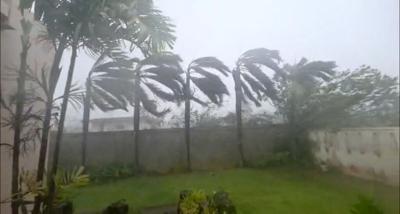
A super typhoon steadily battered a pair of remote U.S. islands in the Pacific Ocean with ferocious winds and relentless rains, shredding tin roofs and forcing residents to take cover from flying tree limbs.
Super Typhoon Sinlaku pounded the Northern Mariana Islands for hours before daybreak Wednesday, slowing just to inflict more damage across the islands of Tinian and Saipan, home to nearly 50,000 people.
“I’m guessing anything that was made of wood and tin did not survive this,” said Glen Hunter, who grew up on Saipan and watched at least three tin roofs fly past his yard.
Hunter, who has weathered numerous typhoons, told The Associated Press this felt like the strongest yet. Rain was seeping into every crevice of his concrete home, he said.
“It was a losing battle because the rain was coming through everywhere,” he said early Wednesday. “Every house is just flooded with water, no matter what type of structure you’re in."
The tropical typhoon — the strongest on Earth this year — was packing sustained winds of up to 150 mph (240 kph) when it made landfall on the islands, the National Weather Service said.
Tropical force winds and torrential rainfall also led to flash flooding on Guam, a U.S. territory to the south with several U.S. military installations and about 170,000 residents, the weather service said.
While wind gusts did slow a bit on the Mariana Islands early Wednesday, the conditions did not improve right away, the weather service reported.
“It’s hitting us hard,” Mayor Ramon “RB” Jose Blas Camacho of Saipan said late Tuesday. “It’s so difficult for us to respond with this heavy rain, heavy wind to rescue people. Objects are just flying left and right.”
Trees were thrown about and wooden and tin structures had collapsed, he said. He was nervously watching the glass door to his office.
“It’s already bending. That’s how powerful this is,” he said.
Typhoon slows, increasing risk of widespread damage
The monster storm slowed to a crawl as it approached the islands.
“This is not going to be an easy night for anyone across Tinian or Saipan. This is going to be a loud night,” said Landon Aydlett, a meteorologist with the weather service. Many people “will wake up to a different island,” he said during a Facebook video broadcast.
Saipan is the largest of the Northern Mariana Islands as well as its capital, known for its resorts, snorkeling and golf.
The worst of the storm hit during darkness and was expected to last for hours until at least sunrise Wednesday, the weather service said. While it’s expected to weaken slightly over the next few days, Sinlaku was crossing the islands as a Category 4 typhoon.
Mariana Islands and Guam are part of ‘Typhoon Alley’
In Guam, where Typhoon Mawar knocked out power for days in 2023, U.S. military officials warned personnel to shelter in place. The military controls about one-third of the land on Guam, a critical hub for U.S. forces in the Pacific.
Before turning toward the Northern Marianas, the storm left significant damage to the outer islands and atolls of Chuuk in the Federated States of Micronesia, Aydlett said from his weather service station on Guam.
The region is known to locals as “Typhoon Alley.”
Tourism-dependent Saipan — the site of one of World War II’s bloodiest battles in the Pacific — was still recovering from 2018's Super Typhoon Yutu when the coronavirus pandemic hit, Hunter said. The economy has yet to rebound, he said.
President Donald Trump approved emergency disaster declarations ahead of the latest storm for Guam and the Mariana Islands. The Federal Emergency Management Agency said it was coordinating support across multiple agencies, dispatching nearly 100 FEMA staff as well as other personnel.
Super typhoons are the equivalent of Category 4 or 5 hurricanes in the Atlantic, with winds of at least 150 mph (240 kph). There have been more than 300 super typhoons identified over the past 80 years by the Joint Typhoon Warning Center in Guam.
Typhoons are “very common” in the Pacific, but the peak season is similar to the Atlantic hurricane season, which runs from summer to fall, said Jason Nicholls, AccuWeather’s lead international forecaster.
“As we’ve seen this year, you can get tropical systems in the West Pacific any time of year,” Nicholls said. “But getting them in April is a little unusual.”
Associated Press writers Patrick Whittle in Portland, Maine; Gabriela Aoun Angueira in San Diego; and Seth Borenstein in Washington contributed to this report.


