There’s a clear top tier of one-and-done prospects in this month’s NBA draft.
BYU’s AJ Dybantsa was widely discussed as the No. 1 pick before becoming a first-team Associated Press All-American. His top challenger for the overall top selection is Kansas combo guard Darryn Peterson, followed by Tobacco Road forwards Cameron Boozer of Duke and Caleb Wilson of North Carolina.
The first pivot point is seemingly set for No. 5 with a wave of one-and-done guards.
With the first round set for June 23, the AP’s initial mock draft starts with the longtime favorite:
1. Washington Wizards: AJ Dybantsa, forward, BYU
The 6-foot-9, 217-pound Dybantsa averaged a national-best 25.5 points by pressuring defenses with his ability to create his own shot, get to the foul line (national-best 229 makes and 296 attempts) and find teammates (3.7 assists). Synergy rated him as “Excellent” in its analytics rankings as the ball handler in pick-and-roll scenarios (87th percentile) and post-ups (94th). He averaged 26.9 points in seven games against top-10 foes, including 35 points in a loss to Final Four-bound Arizona and a near triple-double (29 points, 10 rebounds, nine assists) in an upset of sixth-ranked Iowa State.
2. Utah Jazz: Darryn Peterson, guard, Kansas
There’s no questioning the talent and athleticism, nor the playmaking and scoring skillset. The 6-5, 199-pound Peterson averaged 20.2 points by attacking off the bounce or in transition, shot 38.2% on 3-pointers and made 82.6% of his free throws. The biggest questions arose from his availability. He dealt with a full-body cramping issue that required hospitalization before the season, missed 11 games due to injury or illness and frequently had limited minutes for uncertainty with his day-to-day status.
3. Memphis Grizzlies: Cameron Boozer, forward/center, Duke
The 6-8, 253-pound son of former Duke and NBA player Carlos Boozer became the fifth freshman voted AP men’s national player of the year. He averaged 22.5 points and 10.2 rebounds, capable of finishing through contact (55.6% field goals) or stepping outside (39.1% on 3s). Synergy rated him as “Excellent” against man defense (94th percentile), on post-ups (86th) and spot-up shots (95th). He’s a strong passer (4.1 assists) out of double-teams and while initiating offense, notably assisting on Isaiah Evans’ late 3-pointer to beat reigning national champion Florida.
4. Chicago Bulls: Caleb Wilson, forward, North Carolina
Wilson was an immediate star with explosive athleticism and a spotlight-embracing personality. The second-team AP All-American averaged 19.8 points and 9.4 rebounds while thriving at the rim and in transition with his go-go-go motor. He'll need to add strength to a lean frame (6-9, 211) and improve his 3-point stroke (25.9%). Wilson had a national-best 66 dunks when he went down with a broken left hand in mid-February, then he broke his right thumb in practice when he was on the verge of returning in March.
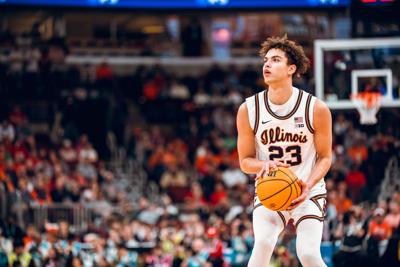
5. Los Angeles Clippers (from Indiana): Keaton Wagler, guard, Illinois
The 6-5, 188-pound freshman went from four-star recruit to second-team AP All-American in leading Illinois to its first Final Four since 2005, averaging 17.9 points, 5.1 rebounds and 4.2 assists. He shot 39.7% on 3-pointers, including hitting nine 3s in a 46-point performance against Purdue. He won the Jerry West Award as the nation’s top shooting guard, though he's a slim build lacking elite athleticism.
6. Brooklyn Nets: Brayden Burries, guard, Arizona
The 6-4, 215-pound freshman combo guard has a sturdy frame and two-way potential. He was the scoring leader (16.1) for a 36-win Final Four team, shooting 49.1% overall and 39.1% from 3-point range. He was fourth at the combine in standing vertical leap (35 inches).
7. Sacramento Kings: Darius Acuff Jr., guard, Arkansas
The 6-2, 186-pound freshman is a dynamic lead guard who ranked third nationally in scoring (23.5) and 14th in assists (6.4). His standout performances included scoring 49 points in a double-overtime loss at Alabama, along with a three-game tear (91 points, 12 3-pointers) for the Razorbacks’ first Southeastern Conference Tournament title in 26 years.
8. Atlanta Hawks (from New Orleans): Kingston Flemings, guard, Houston
The 6-3, 183-pound freshman was a third-team AP All-American as a lead guard capable of being disruptive defensively. Flemings was an efficient shooter (47.6% overall, 38.7% on 3s, 84.5% on free throws) capable of pressuring teams in transition or off the dribble. He finished with a nearly 3:1 assist-to-turnover ratio and posted a Cougars freshman-record 42 points in a loss to Texas Tech.
9. Dallas Mavericks: Mikel Brown Jr., guard, Louisville
The 6-5, 180-pound guard averaged 18.2 points and 4.7 assists, but showed his scoring potential when he went for 45 points and 10 3-pointers against N.C. State in February. There were also three other 29-point outputs. The biggest concern was back issues, which sidelined him for eight games at midyear then resurfaced to sideline him for the final six — including two March Madness games.
10. Milwaukee Bucks: Nate Ament, forward, Tennessee
There’s an intriguing blend of versatility and fluid athleticism with the 6-10, 211-pound freshman, a playmaking passer and No. 2 scorer (16.7) for a team that reached the NCAA Elite Eight. He’ll need to add strength and he leans on his jumper, with spot-up shots accounting for nearly 19% of his usage, according to Synergy. But a monthlong run in the SEC (22.8 points with 39.1% shooting on 3s from Jan. 10 to Feb. 20) highlighted his potential.
11. Golden State Warriors: Yaxel Lendeborg, forward, Michigan
The UAB transfer was a first-team AP All-American who helped the Wolverines win their first national title since 1989. He has a strong frame (6-9, 241) and good wingspan (better than 7-3). He also shot 37.2% from 3-point range in the highest volume of his career and showed a competitive fight in battling through ankle and knee injuries during the Final Four against Arizona and in the title game against UConn.
12. Oklahoma City Thunder (from the L.A. Clippers): Aday Mara, center, Michigan
He stood out — literally — in the massive lineup that powered Michigan's title run and projects as a defensive force. The 7-3, 255-pound junior from Spain averaged 12.1 points, 6.8 rebounds and 2.4 assists while ranking sixth nationally in blocks (2.6). He led all players measured at the combine in standing reach (9-9) and was second in wingspan (7-6).
13. Miami Heat: Labaron Philon Jr., guard, Alabama
The slender 6-3, 176-pound sophomore thrived as a scorer (22.0) and a playmaker (5.0) as a third-team AP All-American, making a leap in his shooting efficiency (50.1% overall, 39.9% on 3-pointers). He thrived as the ballhandler in pick-and-rolls (94th percentile in Synergy) and repeatedly beat man defenses in the halfcourt (90th).
14. Charlotte Hornets: Morez Johnson Jr., forward, Michigan
Another prominent piece of Michigan’s NCAA title run, the 6-9, 251-pound sophomore is a versatile player with physicality, and a strong frame could even have him see time as a small-ball 5-man. He averaged 13.1 points, 7.3 rebounds and 1.1 blocks. He has a better than 7-3 wingspan and thrived as a cutter, in post-ups and in finishing at the rim.
15. Chicago Bulls (from Portland): Cameron Carr, guard, Baylor
The 6-5, 184-pound sophomore transferred after two seasons at Tennessee and blossomed in a lead role with the Bears, averaging 18.9 points, 5.8 rebounds and 2.6 assists while shooting 49.4% overall and 37.4% on 3s. He ranked among combine leaders in standing vertical leap (second at 38 inches) and max vertical leap (third at 42.5 inches).
16. Memphis Grizzlies (from Phoenix via Orlando): Karim Lopez, forward, New Zealand Breakers (Australia)
The 6-8, 222-pound native of Mexico has spent two seasons playing in the National Basketball League’s “Next Stars” developmental program that produced lottery picks LaMelo Ball, Josh Giddey and Alex Sarr. The 19-year-old averaged 11.9 points and 6.1 rebounds last year with his versatility, athleticism and a nearly 7-foot wingspan.
17. Oklahoma City Thunder (from Philadelphia): Jayden Quaintance, forward/center, Kentucky
Health is the biggest question for the 6-9, 253-pound sophomore. The former McDonald’s All-American was a physical, athletic presence at Arizona State before tearing the anterior cruciate ligament in his right knee in February 2025. He transferred to Kentucky but played only four games amid lingering issues in that knee. He was fourth among all players measured at the combine in wingspan (better than 7-5).
18. Charlotte Hornets (from Orlando via Phoenix): Hannes Steinbach, forward/center, Washington
The 6-10, 248-pound native of Germany matched Duke star Cameron Boozer for the national lead with 22 double-doubles after averaging 18.5 points and a national-best 11.8 rebounds in his lone college season. Steinbach shot 57.7% from the field, hit 18 3s (34.5%) and averaged 1.2 blocks with his better than 7-2 wingspan.
19. Toronto Raptors: Bennett Stirtz, guard, Iowa
The 6-3, 186-pound point guard went from Division II to Drake and then to Iowa, where he led the Hawkeyes to their first NCAA Elite Eight since 1987. He averaged 19.8 points, 4.4 assists and 1.4 steals, becoming the first player to lead Iowa in those three categories in 26 years. Synergy rated him as “Excellent” as the ballhandler in pick-and-roll scenarios (91st percentile), working in isolation (84th) and finishing at the rim (90th).
20. San Antonio Spurs (from Atlanta): Chris Cenac Jr., center, Houston
The 6-11, 240-pound freshman arrived as a McDonald’s All-American with rangy skills and outside shooting that made him MVP of the NBPA Top 100 camp in summer 2024. He took a complementary role for a top-10 team, averaging 9.5 points and a team-best 7.9 rebounds. He hit 30 3-pointers (33.3%) to show inside-out ability, graded out well at the rim by Synergy and ranked fifth at the combine in wingspan (7-5).
21. Detroit Pistons (from Minnesota): Dailyn Swain, guard/forward, Texas
The 6-7, 211-pound wing spent two seasons at Xavier before thriving in a lead role with the Longhorns, averaging 17.3 points, 7.5 rebounds and 3.6 assists. He also showed active hands by averaging 1.6 steals. He’ll need to improve his outside shooting after hitting just 34.4% last year and 29.3% through three seasons.
22. Philadelphia 76ers (from Houston via Oklahoma City): Allen Graves, forward, Santa Clara
The 6-8, 226-pound Graves was the West Coast Conference’s freshman of the year and top sixth man in a complementary role. He averaged 11.8 points and 6.5 rebounds while shooting 51.2% overall and 41.3% from 3-point range. He also showed defensive potential by averaging 1.9 steals and 0.9 blocks.
23. Atlanta Hawks (from Cleveland): Koa Peat, forward, Arizona
The 6-7, 245-pound freshman was a key part of a Final Four team that spent nine weeks at No. 1 in the AP Top 25 poll. He scored primarily in transition, on post-ups or as the roller in pick-and-roll scenarios while averaging 14.1 points, 5.6 rebounds and 2.6 assists. He hasn't shown much range (7 of 20 on 3s). Peat tied for fifth at the combine in standing vertical leap (34.5 inches).
24. New York Knicks: Christian Anderson, guard, Texas Tech
The 6-1, 180-pound sophomore was a third-team AP All-American who averaged 18.5 points while ranking fifth nationally in assists (7.4). He projects as a scoring playmaker who shot 40% on 3-pointers over two seasons. He thrived as the ballhandler in pick-and-roll scenarios (93rd percentile in Synergy) and as a spot-up shooter (90th).
25. Los Angeles Lakers: Joshua Jefferson, forward, Iowa State
The second-team AP All-American and senior used his strong frame (6-8, 246) to average 16.4 points and 7.4 rebounds. His passing is a standout skill; he averaged 4.8 assists with the ability to initiate offense and facilitate open looks for teammates while posting a nearly 2-to-1 assist-to-turnover ratio.
26. Denver Nuggets: Ebuka Okorie, guard, Stanford
The 6-1, 186-pound freshman was a surprise star, ranking seventh nationally in scoring (23.2). He’s a bit undersized but had the burst to score in transition or the halfcourt. He posted eight 30-point games, including 40 in a win against Georgia Tech.
27. Boston Celtics: Henri Veesaar, center, North Carolina
The 6-11, 227-pound junior fits today’s desired mold of bigs who can step outside. The 22-year-old from Estonia thrived (17.0 points, 8.7 rebounds) in a breakout year that included shooting 42.6% on 3s (40 of 94) after going just 31.6% (19 of 60) in two seasons at Arizona.
28. Minnesota Timberwolves (from Detroit): Isaiah Evans, guard, Duke
The sophomore offers game-turning ability to heat up from outside, shooting 38% on 3-pointers through two college seasons and hitting at least four 3s in 14 games last year. He’ll need to add bulk to a wiry 6-6, 186-pound frame to handle physical play.
29. Cleveland Cavaliers (from San Antonio via Atlanta): Tarris Reed Jr., center, UConn
The 6-10, 264-pound senior with a better than 7-4 wingspan blossomed as an interior force as the Huskies reached the NCAA title game. He had career-high averages of 14.7 points, 9.0 rebounds, 2.3 assists and 2.0 blocks while showing good touch in the paint.
30. Dallas Mavericks (from Oklahoma City via Washington and Philadelphia): Meleek Thomas, guard, Arkansas
The 6-3, 190-pound freshman is a defense-stretching scorer (15.6) alongside top pro prospect Darius Acuff Jr. He shot 47.9% from 3-point range (56 of 117) after Christmas, a 25-game stretch spanning the Razorbacks’ run to the SEC Tournament title and the NCAA Sweet 16.