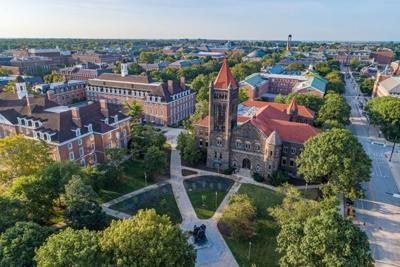
URBANA, Ill. (WAND) - The U.S. Department of Energy has committed another round of funding to the University of Illinois Urbana, Champaign to lead the second phase of its Bioenergy Research Center.
This is one of four large-scale DOE-funded research centers. The centers are focusing on innovation in biofuels, biproducts, and clean energy.
The DOE announced a five-year extension of funding for the Center for Advanced Bioenergy and Bioproducts Innovation (CABBI) totaling $237.9 million for the period between 2017 and 2027.
CABBBI is a collaboration between the university's Institute for Sustainability, Energy, and Environment (iSEE), the Carle R. Woese Institute for Genomic Biology (IGB), 11 academic departments across the campus, and 20 partner institutions around the country.
U.S. Secretary of Energy Jennifer Granholm said, "To meet our future energy needs, we will need versatile renewables like bioenergy as a low-carbon fuel for some parts of our transportation sector. Continuing to fund the important scientific work conducted at our Bioenergy Research Centers is critical to enduring these sustainable resources can be an efficient and affordable part of our clean energy future."
Andrew Leakey, Professor and Head of the Department of Plant Biology at Illinois, will continue to serve as the Director of CABBI. He has held the position since 2020.
"Energy independence has become an increasingly important security issue for the United States, and CABBI will continue to provide breakthroughs toward a new generation of sustainable, cost-effective biofuels and bioproducts that will replace fossil fuels-based products," Leakey said. "This grant represents a massive investment in CABBI and its diverse team of scientists. We are committed to help push the U.S. toward a new bio-based economy."
CABBI researchers will continue to develop fuels and products in Phase II by integrating three interconnected DOE priority areas:
- Feedstock Production
- Conversion
- Sustainability
Leakey said, "Our economy and society will be strengthened by enhancing the productivity, resilience, and sustainability of our agricultural system... and CABBI will help lead the way toward the cutting-edge scientific discoveries and technologies needed to sustainably and profitably produce fuels and chemicals using plants and microbes."
Madhu Khanna, Alvin H. Baum Family Fund Chair and Director of iSEE and a CABBI Sustainability Theme researcher, said iSEE is supporting CABBI research in partnership with IGB and with the College of Agricultural, Consumer, and Environmental Sciences (ACES) to enable research at the 320-acre Illinois Energy Farm and other partner sites.
Khanna said, "One of the world's major challenges is to provide sustainable sources of energy that meet societal needs as the population continues to grow, and Illinois is uniquely qualified to help lead that challenge."
IGB Director Gene Robinson said, "The IGB has over 15 years of experience in successfully addressing grand challenges by transdisciplinary integration of the life sciences, physical sciences, social sciences, and engineering, and we are proud to host the CABBI team. Our partnership with iSEE has been a successful one for five years, and we look forward to five more years of breakthrough discoveries."
Vice Chancellor for Research and Innovation at Illinois and Chair of CABBI's Governance Board Susan Martinis said the university's DOE research portfolio is regarded as one of the top five in the nation.
"The unique partnership between our research institutes and interdisciplinary collaborations across academic disciplines are hallmarks of research at Illinois. IGB and iSEE have built an infrastructure in fields, labs, and virtual environments to allow researchers to do what they do best: solve the world's most pressing problems. For the CABBI team, that means uniting experts nationwide in agriculture, engineering, genomics, biology, chemistry, economics, and more to deliver on the promise of bioenergy and bioproducts innovation."
The Center employes almost 60 faculty researchers, including seven from underrepresented groups who were added since the founding in 2017, more than 160 postdoctoral researchers and technicians, 90 graduate students, and 50 undergraduates, and 15 support staff.
U.S. Senator Tammy Duckworth (D-Ill.) said, "One of the best ways for our nation to strengthen our competitiveness with the rest of the world is to enhance the brilliance that already exists right here in Illinois. I'm pleased that the University of Illinois at Urbana-Champaign's Center for Advanced Bioenergy and Bioproducts Innovation will receive this federal funding to help support groundbreaking research on clean energy, create jobs, address climate change and further secure Illinois's place as a global leader."
U.S. Representative Nikki Budzinski (D-Ill.) said, "As a graduate of the University of Illinois and its proud representative in Congress, I'm honored to join Secretary Granholm in announcing $590 million that will benefit bioenergy research at my alma mater. For the last five years, the University of Illinois has done groundbreaking research at the Center for Advanced Bioenergy and Bioproducts Innovation to revolutionize the role of biofuels and agriculture in our 21st century energy economy. I'm so glad to see funding for this project renewed for the next five years, and I look forward to seeing how these resources will benefit family farmers, our environment, and rural communities across central and southern Illinois."
The BRC Program started in 2007 and led to 4,452 peer-reviewed publications, 845 invention disclosures, 715 patent applications, 298 licenses or options, 261 patents, and 22 start-up companies as of August 2022.


