
SPRINGFIELD, Ill. (WAND) — The Illinois House Judiciary-Criminal Committee approved plans Thursday to help re-open cold cases and provide more transparency on homicide investigations.
One of the plans could allow immediate family members to petition law enforcement to review unsolved murder cases after three years of inactivity. The case file review must include an analysis of steps that may have been missed during initial investigations and assessments of whether witnesses should be interviewed again.

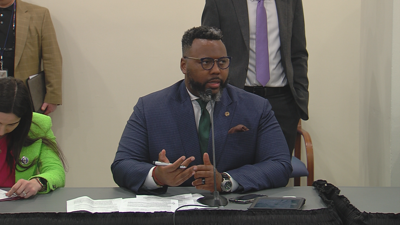
Rep. Kam Buckner (D-Chicago) spoke during a House Judiciary-Criminal Committee in Springfield on April 4, 2024.
Rep. Kam Buckner (D-Chicago) said police should also re-examine if evidence was properly reviewed during initial investigations.
"Each agency is required to employ or designate a minimum number of family liaison officers proportionate to the average number of homicides in the agency's jurisdiction within the previous 5 years with a maximum ratio of 40 homicides per each family liaison officer," Buckner explained.
Family liaison officers would have supportive and ethical relationships with families to build trust and gather information or evidence to re-open cold cases.
Buckner noted that these officers would be the single point of contact between families and investigation teams when a homicide occurs to ensure information is shared in a timely manner. Those officers could also be required to contact the family at least once every 30 days for the first six months the case is open and once per quarter until the case becomes inactive.
House Bill 4753 passed out of the House Judiciary-Criminal Committee on a 13-2 vote. The proposal was placed on the calendar for second reading Thursday afternoon.
"So many families like mine continue waiting year in and out, never getting answers or transparency," said Marsha Lee, an advocate with the Everytown Survivor Network. "Solving gun homicides and assaults is essential to addressing our gun violence epidemic. It helps to increase community trust in law enforcement, breaking cycles of violence in our communities."
Related Links
- Illinois bills could help reopen unsolved murder cases, provide transparent homicide data
- Advocates push for Illinois to require board-certified pathologists conduct autopsies
A separate plan could require every law enforcement agency in Illinois to publish monthly data on homicides and nonfatal shootings, arrests of alleged perpetrators and the status of homicide investigations. Law enforcement would have to submit this information to the Illinois State Police and their official website for the public to view.
"The Homicide Data Transparency Act will give Illinois survivors the ability to find closure when it comes to the murders of their loved ones," Buckner said. "This will help create trust and accountability with Illinois law enforcement and families of victims of gun crimes. I am encouraged by my colleagues joining me in championing this bill and look forward to getting it over the finish line."
The Illinois Sheriffs Association opposes both bills, but the legislation has gained strong Democratic support.
House Bill 4754 passed out of the House Judiciary-Criminal Committee on a partisan 10-5 vote. The plan now heads to the House floor for further consideration.
"When it comes to crime in Chicago and across the state, it's long past time to talk about something new - holding police departments accountable for their failures to solve the city's homicides, especially in Black and brown communities," said Rev. Ciera Bates-Chamberlain, Executive Director of LIVE FREE Illinois. "The transparency required by the Homicide Transparency Act is crucial not only for survivors' peace of mind and healing, but also because it would serve to meaningfully improve what is one of the few tools Illinois residents have to measure their local police department's efficacy."
State representatives could discuss both proposals when they return to Springfield next week.
Copyright 2023. WAND TV. All rights reserved.


