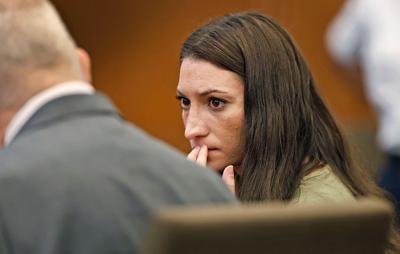
PLYMOUTH, Mass. (AP) — Lindsay Clancy sobbed in court Wednesday as jurors listened to her husband's anguished 911 call after he came back from an errand to find she’d strangled their three children in their Massachusetts home.
On the roughly 7-minute recording, Patrick Clancy can be heard speaking with his wife upon finding her badly injured and bleeding in their yard, after she jumped from the home’s second-story window.
“Look at me,” he says. “Say my name.”
He then tells the dispatcher he's going to check on the children. Moments later, he howls and cries after finding them in the basement. The confused dispatcher repeatedly asks what happened.
“She killed the kids!" he yells.
Three years after the killings, the trial has centered on Lindsay Clancy’s mental state. Her lawyers will seek to prove she had postpregnancy psychosis, a rare mental illness linked to the stress, sleep deprivation and hormonal changes that follow childbirth.
Prosecutors say Clancy, a former labor and delivery nurse at Massachusetts General Hospital, acted intentionally and should be held criminally responsible for the deaths of 3-year-old Dawson, 5-year-old Cora, and 8-month-old Callan in January 2023.
EDITOR’S NOTE: If you or someone you know needs help, the national suicide and crisis lifeline in the U.S. is available by calling or texting 988. There is also an online chat at 988lifeline.org
Her lawyer said Monday she had bipolar disorder, and that antidepressants prescribed after the birth of her third child worsened her condition. On the day of the killings, Lindsay Clancy said she heard voices telling her, “This is your last chance. Kill the children so you can kill yourself,” according to her lawyer.
If convicted of murder, she faces life in prison without parole. If found not guilty due to a lack of criminal responsibility, she would be committed to a state mental health facility.
Patrick Clancy has said in interviews that he forgives his ex-wife, whom he viewed as ill rather than evil.
Husband recounts the day of the killings
Patrick Clancy testified Wednesday that his last image of Dawson was of the boy sitting on the couch eating chicken nuggets and green beans. Lindsay Clancy had asked her husband to make a quick trip for takeout food and medication for Cora at a pharmacy.
Jurors watched surveillance video from the pharmacy showing Patrick Clancy call his wife with a question about which medicine to get.
“She was pretty quiet. It sounded like she was busy,” he testified Wednesday. “I remember hanging up thinking she was probably in the middle of giving baths or something like that.”
Returning home, the house was unusually quiet.
He called out to his family, then searched until finding blood throughout the main bedroom and a window open. Lindsay Clancy had used multiple methods to try to end her own life and remains paralyzed from the waist down because of the fall.
In the yard, she told her husband that the kids were in the basement, without saying they were dead, he testified. He said he didn’t realize he was still connected to the 911 dispatcher as he ran downstairs to find their bodies. Each had been strangled with exercise bands.
Lindsay Clancy's parents, seated in the front of the courtroom, also cried as the call was played. Patrick had already left court after finishing his testimony.
The trial will hinge on Lindsay Clancy’s mental state
Patrick Clancy testified Monday about his wife's deteriorating mental health in the months before the killings, including describing intrusive thoughts of harming the children and of suicide.
Lindsay Clancy had sought care from experts in postpregnancy mood disorders, was put on multiple psychiatric medications, and when nothing worked, checked in to a psychiatric hospital. She killed the children 19 days after she was discharged.
She had appeared to be doing better as recently as two weeks before the killings, Patrick Clancy testified Monday. He said the day of the killings had seemed to be one of her “best days.”
Postpartum psychosis is estimated to afflict only 1 to 2 per 1,000 women after delivery. Experts at the Cleveland Clinic describe it as a mental health emergency affecting someone’s sense of reality.
Postpartum depression is a mood disorder that can also be dangerous but is much more common.


