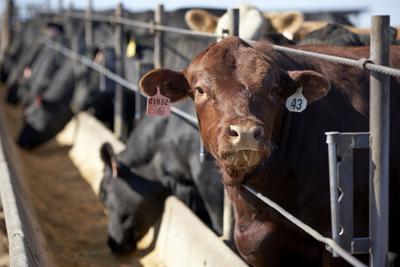
URBANA, Ill. (WAND) — Animal sciences researchers at the University of Illinois Urbana-Champaign are behind a new project to reduce methane production from beef and dairy cattle.
The 3-year, $3.2-million project is part of the Greener Cattle Initiative, led by the Foundation for Food and Agriculture Research (FFAR).
According to the researchers, targeting methane could help course-correct the planet's climate trajectory on a faster timeline than controlling carbon dioxide (CO2) alone.
“What this means is that anything we do now with ruminant animals can have a huge impact on warming within decades, rather than centuries. Our challenge is to reduce enteric methane emissions by about 30 to 40% with the technologies we have,” said project leader Rod Mackie, professor in the Department of Animal Sciences, part of the College of Agricultural, Consumer and Environmental Sciences (ACES) at U. of I.
Six research hubs across the globe are all tackling the challenge of enteric methane, which is produced in the rumen of the cow. The rumen is the largest stomach compartment and works as a kind of fermentation vat for the animal.
Mackie, along with Illinois animal sciences professor Josh McCann, will start by tracking hydrogen production and utilization during fermentation.
“What we'd like is to have ruminants save the planet within 10 years,” Mackie said. “That would be amazing.”
To read more about the research, click here.
Copyright 2023. WAND TV. All rights reserved.


