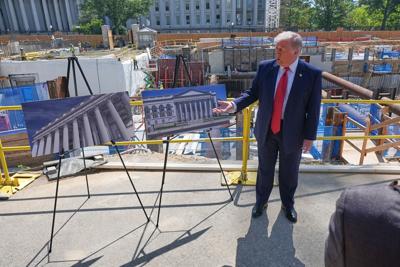
WASHINGTON (AP) — Chief Justice John Roberts on Friday allowed the White House to continue construction on President Donald Trump’s $400 million ballroom project for now, as the Supreme Court considers the Trump administration's emergency request to intervene in lawsuits over the project.
The temporary order came hours before lower-court rulings would have forced a halt to aboveground construction of the project because Trump didn't get congressional approval.
It will remain in place until the Supreme Court issues a more durable decision, though the one-page document does not detail Roberts' reasoning or indicate when another ruling will be handed down. Roberts signed the order because he oversees emergency appeals of cases filed in the capital.
Ballroom case tests the limits of presidential power
The case is coming before the nation’s highest court as Trump, a Republican, exercises unparalleled assertions of presidential power and increasingly seeks to mold the capital in his own image.
The administration has argued that the president has total authority to renovate the White House and other federal buildings as he sees fit and that the ballroom project must be completed due to national security concerns.
When Trump first announced the plans for a new ballroom, he did not emphasize national security. He said the project would be funded by private donations, including from himself.
The National Trust for Historic Preservation argues that Trump has no unilateral authority to undertake the work, which has included demolishing the East Wing. Lawyers for the preservation group accused the White House of trying to “outrun the courts” by accelerating construction.
A spokesperson for the trust said Friday that the order from Roberts is not a final decision and the group is awaiting further action. The full Supreme Court will likely weigh in next on whether construction can continue for the potentially long duration of the lawsuit.
The White House did not immediately respond to a message seeking comment.
While litigation plays out, the ballroom is going up quickly
The Trump administration says 65% of the work has already been completed on the planned 90,000-square-foot (8,400-square-meter) ballroom, where the East Wing stood before the president ordered its demolition.
Crews are working 20 hours a day, seven days a week, on the project, where about $200 million in private donations has been spent or committed, according to court documents filed by the Justice Department.
The work has proceeded against the backdrop of the litigation winding through the courts.
In April a district court judge ordered a stop to aboveground construction of the planned ballroom. That ruling was briefly suspended, then upheld by an appeals court panel. U.S. District Judge Richard Leon in Washington allowed work to continue only belowground on bunkers and military installations. Leon was nominated by President George W. Bush, a Republican.
Leon's decision was upheld by an appeals court panel, as two judges appointed by Democratic presidents found the project was for Congress to decide and “not a matter for Executive self-help.” A third judge, appointed by Trump, found that the preservationist group challenging the project had no legal standing to sue.
Solicitor General D. John Sauer picked up on that argument, calling the decision halting the work “extraordinary and unlawful.” He said the completion of the project was “vitally required by national security.”
The Trump administration has scored a series of victories on the Supreme Court's emergency docket, though the justices have ruled against some of the president’s signature policies after fuller review.
Follow the AP’s coverage of the U.S. Supreme Court at https://apnews.com/hub/us-supreme-court.


